Team Presentations: Look Like a Team

Team Presentations can be effective. But you must invest the time and effort in preparation and delivery that conveys "Team". Too many "Team Presentations" appear as a disjointed collection of speakers.

Tips on How to Convey a Team Image

To help the audience see the relationship between parts of the presentation, each speaker must show how his/her information relates to what came before and what follows.  One way to do this is by referring to what a previous speaker said or what a following speaker will say.
In general, questions should be held until the end of the team’s presentation. However, depending on the topic and the audience, each speaker might devote several minutes to questions immediately following his/her talk.
Team members should design visual aids that are consistent in style (text and graphics).

Dress appropriately but not identically. That only confuses the audience because they can’t tell you apart.

Avoid redundancy and conflicting statements through group practice.

Make the presentation seamless by stating how your part relates to the other parts.

Rehearse the transitions between each speaker.

Another variation is for you to present and bring your technical experts just to answer questions. Coach them before the presentation on their roles and how you will interact.


Presentation Tips on Twitter Presentation Skills Club on Facebook
Executive Speech Coach, Business presentation tips from George Torok, the Speech Coach for Executives

Share/Save/Bookmark

Presentation Tips Video: 3 Parts to Your Presentation

Structure is important to your presentation success. This is a fundamental that many poor speakers overlook. Your presentation needs an Opening, a Body and a Close. The Opening and Close are more important than you might think. Watch this video:


Presentation Tips on Twitter Presentation Skills Club on Facebook
Executive Speech Coach, Business presentation tips from George Torok, the Speech Coach for Executives
Share/Save/Bookmark

Eye Movement for Your PowerPoint Slides

Eye Flow Test

Check the design of your slides with the eye flow test.

1. Where is the first place the eyes of your audience will go when the slide appears?

2. After a few seconds where do the eyes go next? 

3. With a well designed slide you should know the third place their eyes go to.

If you are not sure where the eyes go when the slide comes up – then you don’t know where your audience is looking or what they might be thinking. How can you be on their wavelength if you don’t know their wavelength?

If your slides don’t pass the eye flow test, go back and redesign or remove that offending slide.

How do you know where the eyes go? Test yourself. Look at advertisements in magazines. Notice where your eyes stop first. Ask yourself “why?” Eye flow is easy to predict because of important principles that determine how our eyes move.

Some things to understand about our eyes

  • They jump from point to point.
  • They are attracted to light.
  • They are attracted to motion.
  • They tend to start at the top left of the screen/ page because of the way we learned to read.
  • They look to images before text.
  • They seek familiar patterns.
  • They notice the unusual.

You can learn more about simple graphic design from the book, "The Non-designers Design Handbook" by Robin Williams. This book explains four fundamentals of graphic design which are essential to creating effective visuals.


Presentation Tips on Twitter Presentation Skills Club on Facebook
Executive Speech Coach, Business presentation tips from George Torok, the Speech Coach for Executives
Share/Save/Bookmark

Superior Presentations 61: Build Rapport Rapidly

Build Rapport Rapidly


If you want to persuade people you first need to establish rapport. The sooner you build rapport with your audience, the sooner they will listen to your ideas. The stronger the rapport, the more they will like and trust you.

What is Rapport?

You have rapport with a person when you both see things the same way, which means they must believe that you understand them and see things their way.

If you want to persuade them to see things your way, you must first demonstrate that you see things from their position. Then you might be able to shift their perspective.

How can you build rapport rapidly?

Recognize their Perspective

Point out the challenges and frustrations that they face. You might need to do some research to better understand your audience. The fastest way to connect with your audience is to acknowledge their pain. Everyone wants appreciation of their hardships.

Are they sales people who face cold calling, rising quotas and longer sales cycles? Are they professionals striving for more respect from other colleagues? Are they IT managers juggling impossible demands from customer service and operations?

After you have acknowledged their pain, they might accept that you are in their camp. The next thing to do is to remind them of their strengths, valuable contributions and importance to their organizations. Shift the outlook from negative to positive.

These things will establish a growing rapport with your audience. You'll notice heads nodding in agreement and a keener interest in your message.

Relate Common Experience

Relate an example about how you endured a similar situation. This goes beyond understanding. There is nothing like common experience (especially pain) to bring people together. This principle is captured in the old expression, "The enemy of my enemy is my friend."

Unmask the Elephant in the Room

State the obvious truth that everyone knows but avoids saying out loud. Similarly, you might ask the unasked questions that prey on everyone minds. By giving voice to their repressed thoughts and feelings you become accepted as their friend and perceived as a leader.
Build rapport with your audience to show that you are with them. Then they are more willing to follow your message.


George Torok

Presentation Tips on Twitter
Presentation Skills Club on Facebook
Executive Speech Coach,
Business presentation tips from George Torok, the Speech Coach for Executives

Share/Save/Bookmark

Presentation Tips: Inform, Engage & Move to Action video

The three things you need to do in every presentation to be successful. Enjoy this short video with valuable presentations tips.


Inform, engage and move to action - your presentation formula for success.

Presentation Tips on Twitter Presentation Skills Club on Facebook
Executive Speech Coach, Business presentation tips from George Torok, the Speech Coach for Executives
Share/Save/Bookmark

Should You Speak Behind a Lectern?

Maybe.

I suggest you do not use a lectern. Standing away from the lectern exposes your full body to the view of the audience. You appear more vulnerable, open and trustworthy. The added benefit is that you also appear more powerful and confident with your message.


How Can You Use a Lectern Effectively?

It is helpful to have a stand on which to put your notes. The problem is most speakers hide behind lecterns thereby greatly constraining important body language. 

I urge you to use as few notes as possible. Notes are essential only when you must read a prepared speech, or give a presentation in a foreign language. In that case, a lectern with a light and microphone will help you get through your talk smoothly.
          
Lecterns do make things look official. (Judges always hide behind a lectern.) The seriousness of your topic, the occasion, and the degree of formality in the audience may require that you use one. If so, plan to start and end behind it, but deliver most of your presentation away from the lectern with your whole body in full view.
          
There is one important rule about lecterns: Don't keep your hands gripped on the sides!  This draws listeners’ attention to your nervousness and restrains your body language. 

There are times when you might purposely grip the sides of the lectern to add emphasis to your words. Grasp the lectern only once or twice and lean toward the audience to make your critical points. The contrast helps emphasize what you are saying. 

Practice speaking comfortably without a lectern. If one is available, use it to hold your notes but do not hide behind it as you deliver your talk or you will reduce the power of your presentation.


Presentation Tips on Twitter Presentation Skills Club on Facebook
Executive Speech Coach, Business presentation tips from George Torok, the Speech Coach for Executives
Share/Save/Bookmark

The Chicken Was Better than the Speaker


presentation chicken
The Speaker Read His Speech


What a disappointment. The man had the experience of excellence in both public service and entrepreneurship. In addition he had served the university in many roles over several decades. This was clearly a fascinating person.

You might think that he would have something interesting and engaging to say in his speech.

Instead, he parked himself behind the lectern and dutifully read the speech that someone else wrote for him. Cleary the speech writer wanted to demonstrate his vocabulary by including several ten dollar words. That doesn’t enhance comprehension, rapport or trust.

Occasionally the speaker shifted his stance, planted his hands in his pockets then withdrew them a few minutes later. It looked like nerves not intent. That is not making effective use of body language to support your message.

The presentation was disappointing, boring and uninspiring.

There was nothing personal about this speech. It started with an old joke that got a laugh – but it did not have a point – other than to discredit his credentials. That’s not the same as a personal self-deprecation.

There was no call to action to his audience. I’m not sure why he gave that speech.

We didn’t learn a thing about this fascinating person and I don’t know what he wanted us to do.

That makes for a failed presentation.

It was a wasted presentation. So much potential was lost. What a shame. Oh well, the chicken lunch was good.


Presentation Tips on Twitter Presentation Skills Club on Facebook
Executive Speech Coach, Business presentation tips from George Torok, the Speech Coach for Executives

Share/Save/Bookmark

How to Get Your Point Across in 30 Seconds or Less - book review


How to Get Your Point Across in 30 Seconds or Less

How to Get Your Point Across in 30 Seconds in Less by Milo O. Frank

I first read this book decades ago and have referred to it many times. My copy is marked with pen, highlighter and post it notes.

This book is short – only 120 pages. It will take you more than 30 seconds to read.

If you only read one book on communication skills this is the book to read.

I’ve suffered through many conversations and presentations from people who really needed to read this book. Perhaps you have suffered as well. Buy this book for anyone who loves to make noise without communicating.


What are the best ideas from this book?

You really can deliver an effective message in 30 seconds or less. The author offers several real examples.

You must first be clear about your objective before you can deliver a clear concise message.

The second step is to fully understand the motivation of your listener.

Knowing the first two steps, design your approach because your result is at the end of a process.

The hook is the emotional grabber that tips the argument in your favor. You must have a compelling hook. This is missed by most speakers.

Ask for action. An effective message must ask for action. Don’t hint. Ask! And be clear.

The best 30-second messages take lots of preparation and practice. Don’t wing it.

If you want to be a better communicator you must read this book.


Presentation Tips on Twitter Presentation Skills Club on Facebook
Executive Speech Coach, Business presentation tips from George Torok, the Speech Coach for Executives
Share/Save/Bookmark

The Difference Between Lecterns and Podiums

Lecterns versus Podiums

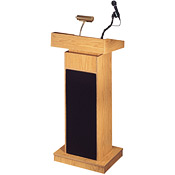
Lectern, not a podium
Many people confuse the words “lectern”, “podium”, “rostrum”, and “dais”. A lectern is the slanted-top high-desk that you as the speaker stand behind and use when reading your presentation notes. It can be placed in the middle of the stage or off to one side. To remember lectern think lecture.

A podium is a raised platform on which a speaker stands during a presentation. To remember podium think podiatrist - which is a foot doctor. You will want to use one, especially if you are short or there are more than three rows of chairs, so as to ensure everyone in the back of the room can see you. Standing on a platform will also dramatically increase your vocal projection.

A rostrum or dais is a larger platform or stage on which a head table might be placed during a formal dinner. 


Presentation Tips on Twitter Presentation Skills Club on Facebook
Executive Speech Coach, Business presentation tips from George Torok, the Speech Coach for Executives

Share/Save/Bookmark