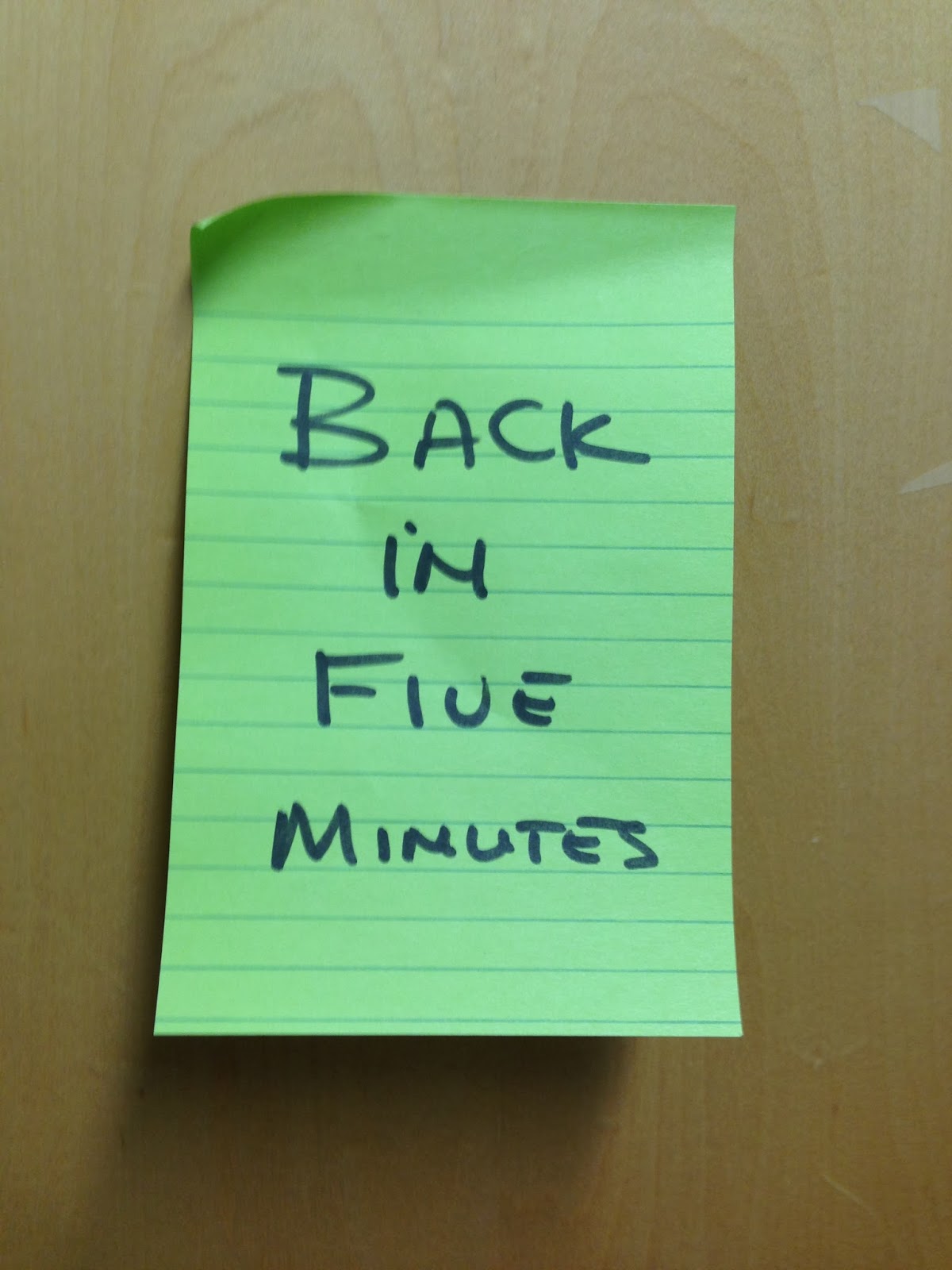
Back in Five Minutes – a lie?


This message on a post-it note was stuck on the office door. What does it really mean?

A few thoughts that went through my mind were:

Five minutes from when?

Why is this person so vague?

How long has this note been on the door?

Why not post the time of your return?

Was this note for the benefit of the reader or the writer?

Was this note posted to be helpful or to provide an excuse?

Does this mean “at least five minutes”?

Does this five-minute promise resemble the same truth (lie) as the statement “just a sec”?

Has this note been there since yesterday – or longer?

What can this person possibly accomplish in five minutes?

Is this person a liar and what other lies has he told?


See what a vague message might trigger in the minds of your audience?


Presentation Tips on Twitter Presentation Skills Club on Facebook Executive Speech Coach, Business presentation tips from George Torok, the Speech Coach for Executives Share/Save/Bookmark

What does your audience want and need?


What does your audience want and need?

It was the Humor Conference. The speaker was a well known humor writer. He was scheduled to deliver a 45 minute presentation about writing humor. At least that’s what the program guide stated.  I attended this workshop because I wanted to learn HOW to write funnier stories.

Anyone who registers for a Humor Conference is already convinced of the need to use humor in their work. The attendees at this conference included teachers, health care workers, consultants, writers, trainers and even business managers. I don’t recall meeting any bankers or government bureaucrats. Several people had a generous supply of red noses to share with new acquaintances.

The humor writer started his presentation by addressing the question about “why humor was important”.

These thoughts went through my mind. Yeah, we get it. That’s why we’re here. Please move on to explain the techniques about HOW to write humor.

While he continued to speak about the WHY I perused the handout materials and it looked like good tips about the HOW were planned.

At 20 minutes into his presentation I lost my patience at listening to the WHY of humor and raised my hand. When he acknowledged me, I stood up and suggested that we were there because we already embraced the WHY. We really wanted the HOW and I was concerned that he might not have enough time to adequately cover the techniques indicated in his program materials. Please skip to the HOW portion of the presentation so we won’t miss out.

Clearly this presenter was unwilling or unable to adapt because he failed to address my question and request. He simply carried on with his (poorly) planned presentation which included another 10 minutes talking about the WHY.

When the time was up - much to his apparent surprise - there were still a few pages of tips to cover and he cut his presentation short.

I left that presentation feeling cheated because I didn’t hear what I really wanted. In addition when I expressed my feelings to the presenter he ignored me and my message.

I understand that he was a writer – not a presenter. Many writers are asked to speak because of their profound writing, but what some conference organizers don’t realize is that writing and speaking are related but two very different skill sets.

There are three key points to this post:

Understand and address the real needs and wants of your audience.

Be prepared to adapt if your audience indicates that you need to change tactics. (He didn’t need to accept my opinion. He could have polled the audience about their interest.)

Just because a person is an expert on their topic doesn’t mean that they can present it well.


Presentation Tips on Twitter Presentation Skills Club on Facebook Executive Speech Coach, Business presentation tips from George Torok, the Speech Coach for Executives Share/Save/Bookmark
Superior Presentations 73: While presenting, the most important real estate...

The most important real estate is in the minds of your listeners


To be successful with your presentation you need to get your message into the minds of your audience. You can't force your way into a person's mind. You must present your message in a way that encourages them to invite you in.

Have you ever witnessed a parent lecturing their child while posing this silly question, "How many times do I have to tell you?"

In this case the reason for failure for the message to stick is because the child didn't accept the message. The parent was attempting to force the message in.

Some presenters commit the same crime then blame the audience for not listening.

If you try to force-feed your message to your audience you will fail. Your message and information might be important but if the audience doesn't see it that way your message won't stick.

What can you do to encourage your audience to willingly accept your message into their mind like a welcome guest?

Do some research and thinking to gain a better understanding about your audience.

  • Why are they attending this meeting?
  • Why might they be interested in your message?
  • What perspectives, beliefs and information might they already have about this topic?
  • How might their priorities, mindset and emotions block your message?

Examine your message from their point of view.

  • What aspects should you emphasize?
  • What misconception should you clarify early?
  • What experiences or emotion can you leverage?
  • How is this relevant to them?

Speak to your audience as a welcome guest.

  • Speak in their language using terms and phrases that they fully understand.
  • Relate your message to their issues and priorities.
  • Find common ground to establish rapport.
  • Admit a flaw or potential concern.

The success of your presentation will be determined by the thoughts triggered inside the minds of your listeners because that will determine how they think and feel and most importantly how they act.

To be more successful with your presentations think about that prime real estate and deliver your message as a welcomed guest.


Presentation Tips on Twitter Presentation Skills Club on Facebook Executive Speech Coach, Business presentation tips from George Torok, the Speech Coach for Executives Share/Save/Bookmark

Life After Death by PowerPoint 2012 by Don McMillan

You can laugh when you watch this - then check your own PowerPoint slides.


Presentation Tips on Twitter Presentation Skills Club on Facebook Executive Speech Coach, Business presentation tips from George Torok, the Speech Coach for ExecutivesShare/Save/Bookmark

Words and Phrases you use when Speaking to Groups


The words and phrases you use when speaking to groups can build rapport or trigger disconnects. That could be based on different cultural, age, or sex perspectives.

Sometimes the gaff can seem cute. Other times the misspoken phrase might send your audience off on a tangent. They might be wondering what that phrase means. They might be wondering about your credibility if you used such an out-of-date phrase. The point is that they might be wondering many things other than accepting your intended message.

The speaker talked about Crisis Management and how to prepare. He suggested that it was similar to noticing the engine warning light on your car. When you see the trouble light warning you of a problem you should take your car to the gas station to get it checked.

If you don’t understand that last statement, you understand my point.

If you remember taking your car to the gas station for mechanical work then you are probably reminiscing about the 1970’s or earlier.

It was a good analogy. His mistake was in saying that people should take their car to the gas station. It would have worked better if he had said “take your car to a mechanic”.

This audience clearly included many people who would not understand this analogy because they were too young. These were people who go to a gas station to get gas, coffee, snacks and cigarettes. Those last three items weren’t available at the gas station when you took your car there for mechanical work.

Be aware of the analogies, phrases or jargon that you use because these words might alienate, distance or confuse your audience.


Presentation Tips on Twitter Presentation Skills Club on Facebook Executive Speech Coach, Business presentation tips from George Torok, the Speech Coach for Executives Share/Save/Bookmark

Lousy opening to your presentation


Lousy opening to your presentation

The purpose of your opening is to build interest in your presentation. Your opening is like the opening paragraph of an article or the first chapter in your book. The question it should answer is “Why should the audience listen to your presentation?”

Sometimes we need to experience a bad example to really appreciate the difference. Here is an example of a bad opening---

The speaker said:

Good morning, good afternoon or whatever.
Guess I’m a little jet lagged. Ha.
Glad to be here in Toronto.

I’m the founder of…
We are based in California.
We have offices around the world.

Where’s Robert?
There he is.
He is my local licensee.

We’re running 15 minutes late and I had planned to speak for one hour and fifteen minutes and I plan to use all of that time.

~~~~~~~~~~~~~~~~~~~~~~~~

The purpose is to build interest in listening to the rest of the presentation. Nothing he said in his opening did that. From that opening one might surmise that this speaker would be a pompous braggart and an inconsiderate boring speaker.

The audience makes those decisions during your opening.

We know what he didn’t do. Let’s dissect his opening to recognize what he did wrong.

 
Paragraph 1: Good morning

That’s cliché and boring. He started speaking at 4:00pm yet he didn’t know the time of day. That demonstrates lack of awareness and disregard for his audience. We don’t care about his alleged jet lag. That was his way of bragging that he travelled to get here. Glad to be in Toronto sounded insincere and it was cliché.

 
Paragraph 2: I’m the founder

The place for that information was in his introduction. It was in the introduction and for some reason he felt that he needed to repeat that. Why? Was he insecure? It seems those things were important to him and perhaps his mother?

 
Paragraph 3: Where’s Robert?

At some point Robert and his relationship might become significant. At this point, who cares?

 
Paragraph 4: 15 Minutes Late

Did he just criticize the organizers? Then he added that he was unwilling to adapt and didn’t care about the audience time expectations. He implied that the time of the audience was unimportant to him. It was more important that he exercise his desire to speak as long as he likes.

 
If you heard this opening -

Would you like this person?
Would you feel interested in his presentation?
Would you want to do business with his company?

 
Check the opening to your presentations. Avoid these mistakes.


Presentation Tips on Twitter Presentation Skills Club on Facebook Executive Speech Coach, Business presentation tips from George Torok, the Speech Coach for Executives Share/Save/Bookmark

Superior Presentations 72: Build your presentation argument on...

Build on what they already know


When you are introducing a new idea or concept to an audience you will have better success if you build on what they already know.

Teachers often review the key points from the last class to start on familiar ground and build upon it.

When Steve Jobs introduced the iPhone he related to objects that people are already familiar with. He even showed an image of a mobile phone with a dial. He did that for two reasons: to get a laugh and to demonstrate that the iPhone was simply the advancement of a familiar tool.

Albert Einstein explained his theory about relativity by using the analogy of a man walking on a moving train. People were familiar with train travel so they felt comfortable listening to the rest of his analogy. That analogy clearly explains the relationship between the speed of light, time and space. (It's worth reading)

When molecular scientist Neils Bohr first described the structure of atoms he used the structure of the solar system as a model. The sun represented the nucleus while the planets symbolized orbiting electrons.

The retention of old skills is often likened to "like riding a bicycle".

This is not about talking down to people. It's about connecting with them by starting with familiar territory and mindset then bridging to where you want to take them.

This technique also helps when persuading people to accept a different way of doing things, especially if you want them to abandon the established norm.

You might start your argument by confessing your past belief in the status quo until an accident provoked you to investigate other possibilities. You fought change but finally accepted the new reality. This approach allows the audience to follow your path of discovery without feeling foolish or defensive.

Introducing new ideas? You can't stand on the other side of the chasm and tell people to jump. If you want to move your audience to new ground you must first go to them and lead them across the bridge.

Presentation Tips on Twitter Presentation Skills Club on Facebook Executive Speech Coach, Business presentation tips from George Torok, the Speech Coach for Executives Share/Save/Bookmark

3 Sales Presentation Openers to Avoid

Guest Post by Kelley Robertson

During the last 17-plus years I have been part of, or watched, hundreds of sales presentations. More recently, I viewed a series of sales demonstrations and all but one of the four sales team opened their presentation the same way.
Here are three openers you need to avoid using when starting a sales presentation.

Social chit-chat

Contrary to popular belief, spending time at the beginning of a sales presentation engaging the prospect in social chit-chat to create rapport is not a good use of time. You may think it’s important but your prospect doesn’t really care. They are busy and want you to get to the point—quickly—so they can get back to work.
There are two exceptions to this rule…
1. If you are doing a presentation for multiple people and you are waiting for people to arrive, it is perfectly acceptable to engage the others in small talk. However, once everyone has shown up, get started immediately.
2. If your prospect engages you in small talk then it makes good business to participate. Otherwise, don’t waste their time–or yours.

Thanking the prospect

Most of the sales presentations I have observed start with the sales person(s) thanking the prospect for the opportunity to present their solution. This behavior diminishes your credibility and puts you in a submissive position. Plus, it doesn’t any add value to the presentation.

Talking about your company

This is perhaps the worst mistake. The vast majority of sales presentations I have seen open with the seller talking about their company.
  • How long they have been in business
  • The clients they have on their roster
  • The awards they have won
  • The list goes on
After more than 17 years of working with sales people I still don’t know why sellers think this is an effective way to open a sales presentation.
First impressions are critical. And if you make the wrong impression in the first vital moments of a sales presentation you run the risk of losing that opportunity.

Improve your next sales presentation with my free eBook “58 Ways to Create Compelling Sales Presentations” Download it here: http://bit.ly/Rd0deV

Kelley Robertson is a specialist in sales training.


Presentation Tips on Twitter Presentation Skills Club on Facebook Executive Speech Coach, Business presentation tips from George Torok, the Speech Coach for Executives Share/Save/Bookmark

Bill Gates - still not a confident public speaker

Just because you are rich doesn't make you a good public speaker.

Bill Gates is one of the richest guys in the world. He is successful. He is a brilliant thinker. Yet he isn't a good public speaker. 

The reason I tell you that is because none of those things gurantee public speaking brilliance. That means that the lack of financial success need not limit your public speaking success.

I watched Bill Gates speak at an event in Toronto about ten years ago. He was cleary uncomfortable about being on stage. He was accompanied by two others on stage while he talked. They all sat on stools. Bill didn't allow any humor about himselt - only about the competion and Windows.

In this video, as Bill Gates speaks to Harvard graduates, he pokes fun at himself. But he reads his speech, which is suprising, because he's telling his personal story. He doesn't need to read it because he lived it. He does demonstrate good pacing and pausing to allow for the laughter.

Bill Gates still isn't comfortable speaking in public but he's getting better.


Presentation Tips on Twitter Presentation Skills Club on Facebook Executive Speech Coach, Business presentation tips from George Torok, the Speech Coach for Executives Share/Save/Bookmark